 Last additions - How-to Last additions - How-to |
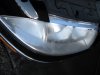
352 viewsBefore...Jan 23, 2010
|
|
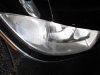
355 views...after.Jan 23, 2010
|
|

410 views...and after!Jan 23, 2010
|
|
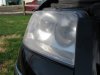
379 viewsRight headlight before...Jan 23, 2010
|
|

348 viewsBefore...Jan 23, 2010
|
|
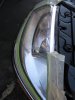
344 views...after first pad...Jan 23, 2010
|
|

355 viewsTa-da! Big improvement. Neither one looked brand-new but they sure looked a LOT better after I was done. At least now you can see reflections in the plastic cover. You couldn't see them before.Jan 23, 2010
|
|
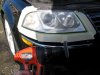
359 viewsPut tape around the headlamp to protect the paint. I initially used a battery-powered drill (pictured) but the battery was low on charge so I switched to my 6-amp drill. Locked the trigger on and started polishing. Very easy to do and I overlapped per the instructions, moving roughly a half-inch, back-n-forth across the headlamp then some lesser work on the turn signal area (it wasn't as badly pitted).Jan 23, 2010
|
|
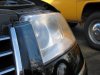
361 viewsLeft headlamp before. Lot's of abuse hitting that plastic!Jan 23, 2010
|
|

325 views...after second pad.Jan 23, 2010
|
|
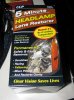
374 viewsThis is it. Comes with pad holder and six polishing pads. It was $9 less than the 3M product and worked great. The headlights were badly pitted but not quite yellowed. I think glass covers would've been a better idea but... I used one pad per headlamp/turn signal (the whole headlight cover) then used another pad that I shared between the headlamps so for my application it was 1.5 pads per headlamp. If your covers aren't as bad then one should be fine.Jan 23, 2010
|
|
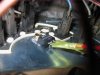
570 viewsClose up of mounting the VR to the back of the gauge body.Jan 09, 2010
|
|
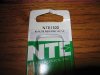
509 viewsHere's the VR (voltage regulator) information. This is what you need. I got mine for $3.15 at Norvac Electronics, Inc. You can also get it at Fry's. NTE1932, IC voltage regulator, positive 10-volts, 1-amp.Jan 09, 2010
|
|
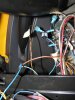
608 viewsWhat it looks like under the dash when put back together. The resistors aren't touching anything and there's no tension on them.Jan 09, 2010
|
|
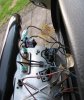
589 viewsAnother view.Jan 09, 2010
|
|
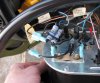
622 viewsAll connected. Use the Bentley wiring diagram to assist but this is basically how it's wired. Remember, you're simply replacing the vibrator with the VR and using a resistor pack in-line with the fuel gauge sender to bring the voltage down to a reasonable level.
+12V (black wire from gauge cluster) -> VR -> gauge -> resistor pack -> tank sender (brown w/black stripe wire)Jan 09, 2010
|
|
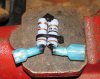
536 views...as can be seen here. I again used Plasti Dip to cover/protect the exposed wire. Use one female spade and one male spade connector. The female will be connected to the fuel gauge and the male will be connected to the brown with black stripe wire that goes to the fuel gauge sending unit.Jan 09, 2010
|
|
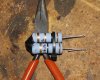
512 viewsI used a small zip-tie to keep the resistors together while working on them. Not critical to have but makes the pack more sturdy and easier to handle. You can also see that I bent the wires back on themselves, essentially making them thicker. This allowed me to crimp spade connectors to them...Jan 09, 2010
|
|
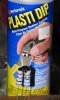
523 viewsI used "Plasti Dip" over the joint as it's an electrical insulator and will protect the joint. It's thick and simply paints on.Jan 09, 2010
|
|
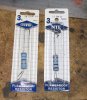
560 viewsHere are the resistors...beefy! They are 3 watts each. If you use a smaller wattage resistor they will get hot!! These will get warm but not hot. One is 1-ohm and the other 16-ohms. You wire them in series so you get a total of 17-ohms resistance. So you can use any combination of resistors you want, just shoot for 17-ohms. This puts my gas gauge needle right on the first white mark (left side) of the red Reserve section but the needle will go a little past the Full mark when the tank is topped up. Add more resistance to have the needle move down more but I'm guessing that a total of 20-ohms would be the max to use.Jan 09, 2010
|
|
| 334 files on 17 page(s) |
 |
10 | |
|





